Letters · Shaibyaa Rajbhandari · 10 min read
Saying yes to four dresses
Three days, four outfits, and what I learned about choosing clothes you can still breathe in.
Bridal outfit shopping is a beast on its own. Multiply that by three days and four distinct outfits and it becomes a beast with four heads.
Luckily, I had been following bridal couture for years and had a hundred looks saved since I was probably fifteen, along with a very clear sense of which designers and aesthetics felt like me. So choosing four wedding outfits in under six months was less of a Herculean task than most wedding websites would have you believe.
And to be fair, people are not wrong when they tell brides to start early. Wedding fashion timelines are tight – you need at least three to four months for custom outfits from top designers.
I also ended up shopping across two completely different bridal ecosystems: white wedding bridal fashion in the U.S., and traditional South Asian fashion across India, Nepal, and Sri Lanka.
Which taught me that bridal fashion is not really about clothing. Weddings force women to make permanent visual decisions while simultaneously imagining themselves as twelve different people at once. Are you the minimal bride? Traditional bride? Sexy bride? Fashion bride? Timeless bride? A woman who will look back at these photos in twenty years and feel elegant, or emotionally victimized by trend cycles?
I knew that if I threw myself directly into the world of couture, I would just get overwhelmed. So before I started shopping seriously, I did the same thing I had done for decor. I wrote down what actually mattered to me.
What I wanted
1. To be able to move.
I have seen too many South Asian brides spend the GDP of a small island nation on lehengas they physically cannot walk, dance, sit, breathe, or raise their arms in. And while yes, the outfit may look incredible in still photographs, there is something both funny and faintly tragic about watching a bride trapped inside the same garment she spent thousands of dollars on.
I wanted to dance, move through crowds comfortably, hug people properly, and survive multiple days without feeling like an upholstered dining chair. So in Asia, I often found myself looking at bridesmaid or guest collections instead of formal bridalwear, because those outfits were usually significantly lighter.
2. To feel timeless.
Not “timeless” in the fake minimalist internet way where everyone suddenly wears identical satin gowns and calls it quiet luxury. I mean timeless in the sense that the outfits would still emotionally make sense to me years later.
I wanted wedding fashion that felt more like a Balenciaga City bag than the kidney-shaped Dior saddle bag everyone becomes emotionally obsessed with for twelve months before collectively abandoning. For the white gown, for years, one of my references had been Carolyn Bessette-Kennedy's Calvin Klein wedding dress. Clean. Elegant. Uncomplicated. Then Love Story released and it became everyone's reference.
Which also meant I started panicking slightly whenever certain bridal aesthetics became too trendy online. The more aggressively repeated a look became across Instagram, the less emotionally attached I became to it.
3. To rewear them.
I was not opposed to spending a substantial amount on fashion, because I had intentionally budgeted for it. But I also did not love the idea of preserving outfits in garment bags for the next forty years because there was nowhere to wear them afterward.
This is obviously harder with white gowns — unless you plan on regularly rewearing your wedding gown to black-tie dinners, there are limits. But with South Asian clothing especially, I tried thinking modularly. Could the blouse work separately? Could the skirt be reworn differently? Could the jewelry be styled again? Could parts of the outfit survive beyond “bridal”?
The price tag became much easier to justify when the pieces still felt connected to my future life instead of existing for one performance of bridehood.
4. To survive the climate.
I got married in peak April heat in Sri Lanka and knew that as beautiful as a heavily embroidered lehenga might look in photographs, it could also realistically give me sweat marks and heat stroke.
I once attended a wedding in peak Udaipur heat where my friend wore a lehenga that probably weighed fifteen kilos. For the first thirty seconds of her entrance, she looked unbelievable. Then three people had to carry sections of the lehenga down the stairs. By the garland exchange, she was sweating, in pain, and changed out of the $20k outfit within an hour.
I love her deeply. But I absolutely did not want to become like her.
Three days, four outfits
Day one was Indo-Western, so I was specifically looking for a saree gown or a fusion outfit. Day two was the Catholic ceremony, which I left to the US gown shopping — a whole separate story. Day three had two events: the Nepali ceremony, which meant a red saree, and the reception, which was Nepali glam, so another saree or a lehenga.
The shopping
I started my outfit hunting journey with my golden bridal WhatsApp group: eight friends with eight completely different opinions. And my mother, surviving each appointment on tea and cookies while I tried on what was probably ten outfits per store.
Being from Nepal, I had decided that most of my outfits would be traditional, barring the Western one for the Catholic ceremony. I also decided to go with Indian designers. I had four straight days of appointments lined up in Delhi. Then a three-day break for a friend's wedding where I would mentally shortlist everything, before coming back to Delhi for two final days to actually make decisions.
Insane setup. But that break was useful, because otherwise everything starts looking the same.
Inside the South Asian ecosystem
If you think you have already seen enough gown variations, you simply have not entered the South Asian bridal ecosystem yet. There are lehengas, sarees, saree gowns, corsets, mirror work, sequins, feathers, embroidery, and every color under the sun.
And unlike Western bridalwear, where most gowns still orbit around some variation of white femininity, South Asian bridalwear allows for dramatically different identities depending on the designer, silhouette, embroidery, styling, and color story.
Color first
Before you even begin shopping, do a color analysis on your face. You do not need to fly to Seoul. ChatGPT can genuinely help. Upload photos of yourself in different colors. Ask about undertones. Ask why certain shades make you glow while others make you look vaguely deceased.
I discovered I have warm olive undertones, which immediately eliminated entire families of colors I had always assumed I would wear. It also unexpectedly led me to the blue reception outfit I ended up loving, even though blue was never part of the bridal palette I had imagined for myself.
Even something as simple as “bridal red” is not actually one color. Tomato reds, wine reds, rust reds, maroons, blue-toned reds — they all photograph differently and flatter different undertones. The same goes for pastels. Not every pastel belongs on every person, no matter how beautiful it looked on Anushka Sharma.
Then the geometry
Comfort in your own skin matters. But I think brides deserve more honesty here instead of everybody pretending everything looks amazing on everyone. Different silhouettes create different visual proportions. That is just geometry.
Sarees are more flattering than lehengas on most body types. Lehengas visually cut the body horizontally. Sarees create one continuous vertical line and move more naturally. Longer skirts photograph better. Heavy cancan can swallow petite brides alive. Stiff fabrics widen the body visually. Lower-waisted lehengas are not emotionally safe after a large dinner. And tailoring sometimes matters more than the designer label itself.
The biggest thing is this: you should not spend your entire wedding thinking about your body. If you are constantly adjusting your blouse, sucking in your stomach, pulling at fabric, or unable to breathe properly, you will experience the wedding differently.
The goal is not becoming the most beautiful bride in recorded human history. The goal is looking like yourself at your absolute best while still being able to eat butter chicken, breathe properly, and dance.
Then the designers
What helped me enormously was realizing that most major Indian designers have very distinct design languages. Once you understand their “woman,” it becomes much easier to understand whether their clothes actually align with you. Because at the higher end of South Asian bridalwear, you are not just buying a lehenga. You are buying into an aesthetic universe.
Some specialize in maximalism. Some in softness. Some in old-world elegance. Some in glitter powerful enough to temporarily blind your fiancé under direct lighting.
A lot of brides walk into stores asking what's popular right now, what are brides wearing this season, show me the piece you made for Priyanka Chopra. But I think the more important question is: what version of myself do I want to look like?
If you want regal old-school Mughal embroidery and heavier traditional work, you go toward Rimple & Harpreet or Ritu Kumar — but maybe not if your wedding is in peak summer and you would like to remain conscious. If you want the strongest understanding of color contrast, styling drama, and brand prestige, you go to Sabyasachi, but not if you expect limitless customization. If you want understated luxury and outfits you can actually breathe in, you go to Tarun Tahiliani. If you want glitter and high-glam red carpet energy, Falguni Shane Peacock. If your lifelong dream is to look like a Bollywood heroine covered in crystals, Manish Malhotra. And for embroidery and sequins that genuinely feel couture-level, Rahul Mishra.
The four outfits
For the welcome night, I tried on close to fifty outfits and was completely exhausted by the end of the day. One of the hardest parts of shopping in India is that most stores do not allow photos, so by nighttime your brain becomes a corrupted hard drive trying to remember whether the gold lehenga with sequins was the same gold lehenga with slightly different sequins.
We debated the few photos I had before I went to sleep. Thankfully, some sales assistants — like the woman at Tarun Tahiliani — sent me pictures afterward. The next morning, half-awake and sending thirty screenshots into the group chat, I kept coming back to one outfit. Slowly, all my friends started saying the same thing. It was the only unanimous “this could work” moment of the entire trip.
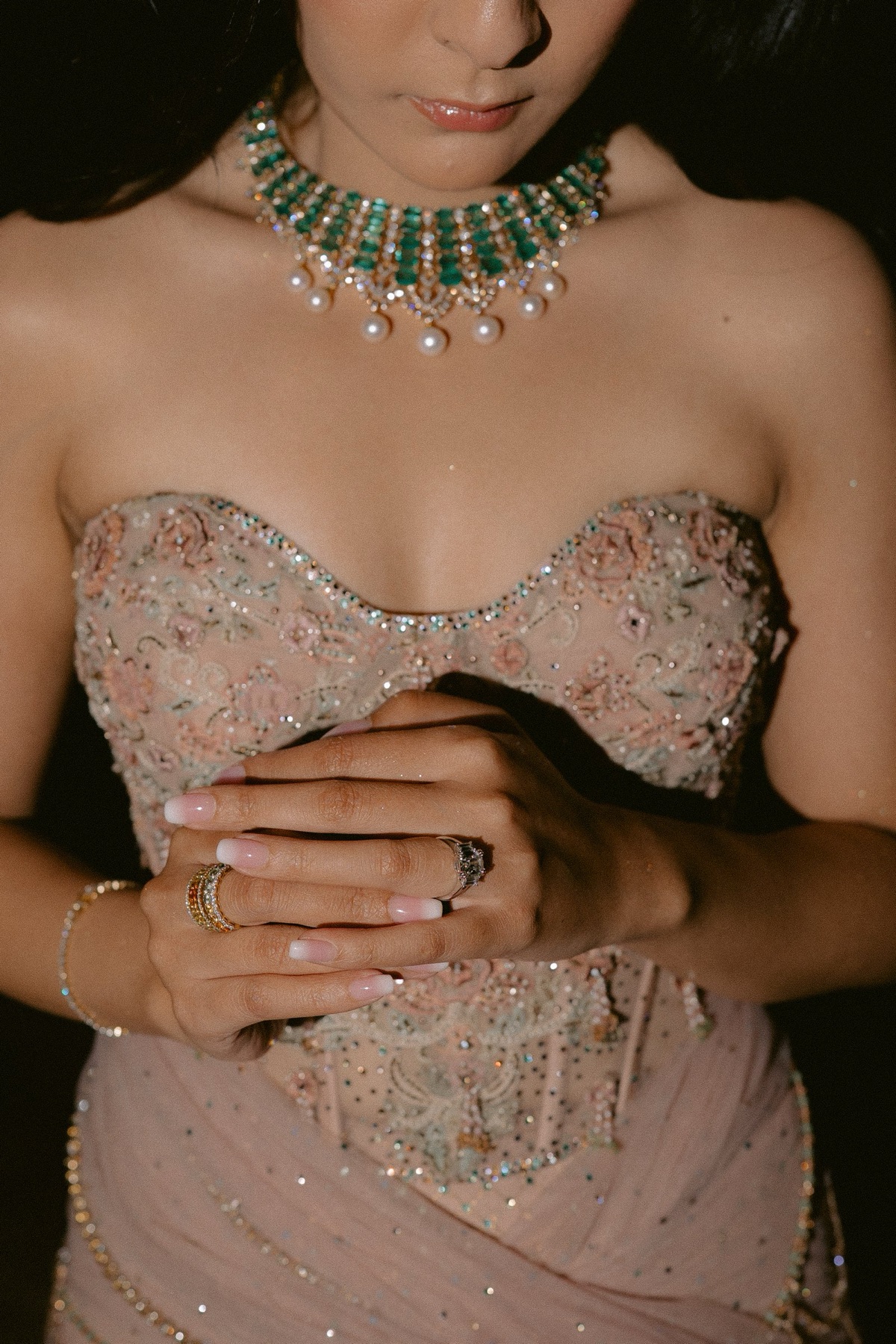
It was a corset lehenga gown — exactly the Indo-Western direction I wanted for the evening. After trying what felt like twenty-kilo lehengas all day, this one felt like walking on clouds. I could also rewear the corset in the future with chic pants and a blazer. Bonus points. Then the store stylist paired it with emerald jewelry, and my color analysis confirmed the same. That was the moment I knew I wanted a statement emerald choker.
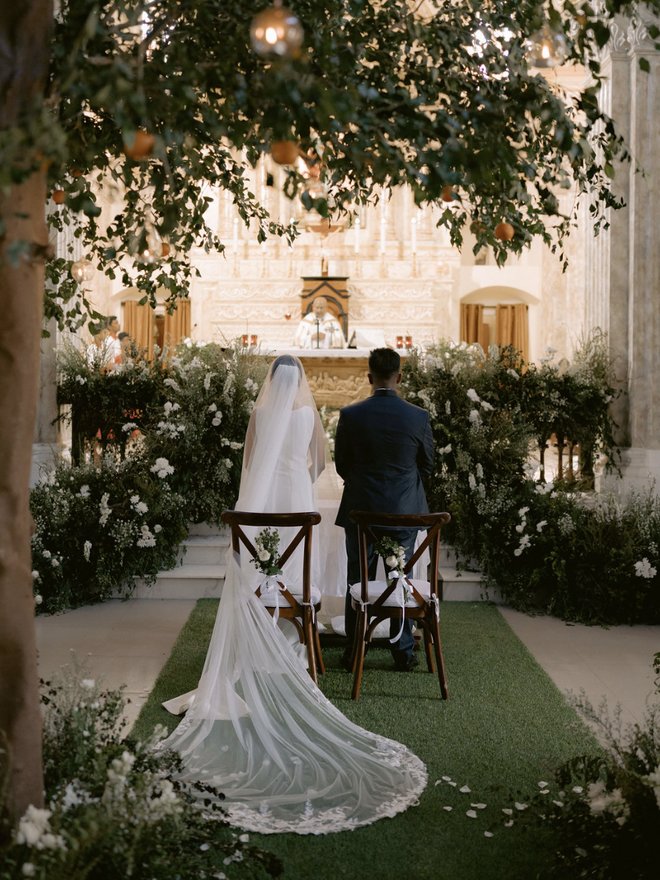
For the church ceremony, I kept going back to Carolyn's gown. Even decades later, it still feels modern — but more than that, she looked comfortable in it. Relaxed. Like she was actually enjoying herself instead of performing bridal suffering. Together with my designer, Aslam Hussein, we started imagining what a modern version of it could feel like.
Since the welcome outfit was off-shoulder, we added sleeves to this one. But because the dress was so minimal, I wanted small moments of drama elsewhere — so I chose royal blue Manolos instead of baby blue, and long dangler earrings to contrast the simplicity of the gown. If I could redo it, I might explore sapphire studs too.
For my Nepali wedding look, I always knew I wanted to be a bride in red — which usually means a traditional silk Benarasi saree. The problem was that I struggled to find the exact deep blood-red tone that actually suited me. Typically, families already own these sarees and the older ones are usually the best quality, but none of the ones I tried felt quite right. I also knew I did not want to physically melt in April heat.
Ironically, I had not gone into Sabyasachi intending to buy a saree at all. But this one stood out immediately because of the color and simplicity. Since we were postponing the full Nepali ceremony to the following year, it also emotionally felt like the right version of bridal for that moment: traditional, but lighter and less ceremonial. Because the saree itself was relatively restrained, I paired it with a dramatic gold necklace that still worked with the border detailing, chose studs so the jewelry would not overpower either the blouse or the necklace, and slightly oxidized the gold to better match the richness of the red.
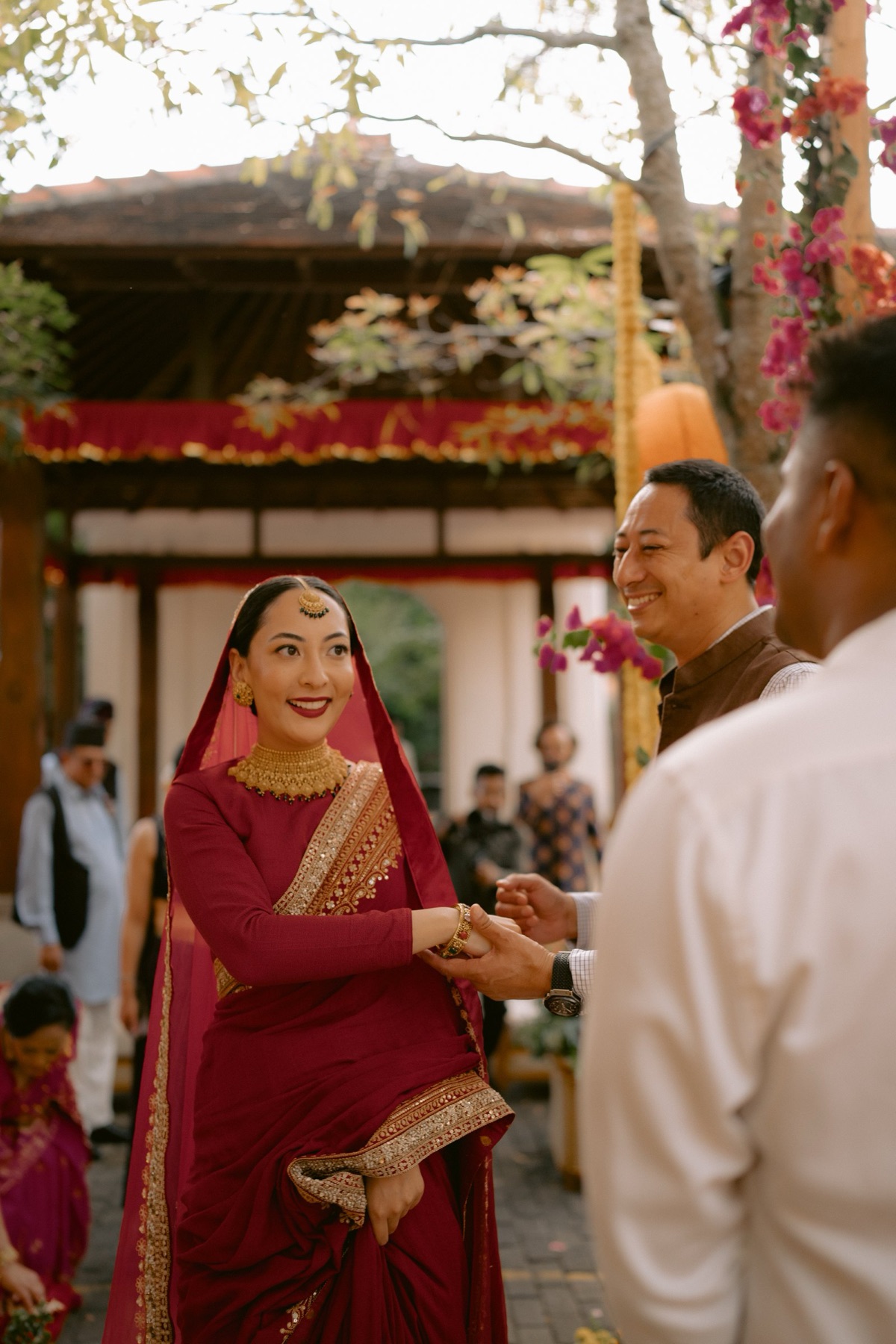
For the post-wedding party, I knew I could not survive in a full-sleeved blouse forever. I also wanted something playful — an outfit that still felt exciting after multiple days of bridal dressing.
No designer excited me more than Rahul Mishra. Even after initially saying no to one look, I found myself thinking about it constantly afterward. Specifically, dreaming about it in blue.
The starting reference was the Zendaya look he had designed, but I didn't want to wear something too recognizable, or spend my own wedding being compared to Zendaya, which felt like a deeply unwinnable competition. What I did know was that I loved the blue. And according to ChatGPT, it was supposedly one of my best colors.
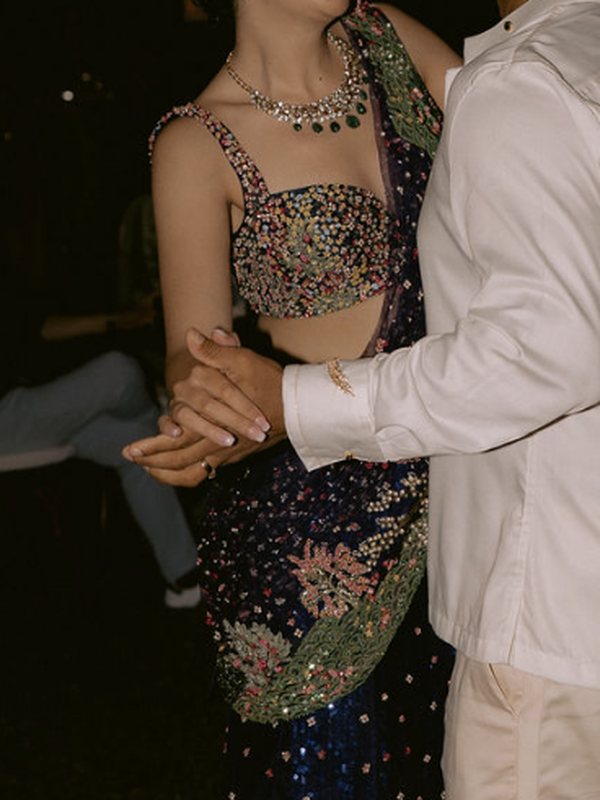
And this time, I actually bought the polki set before the outfit itself, which ended up helping me choose between doing the look in blue or pink.
The jewelry decided before I did.
From Dear Darling, You're Not Just Planning A Wedding
Married too? Review your vendors →